ARIA-88
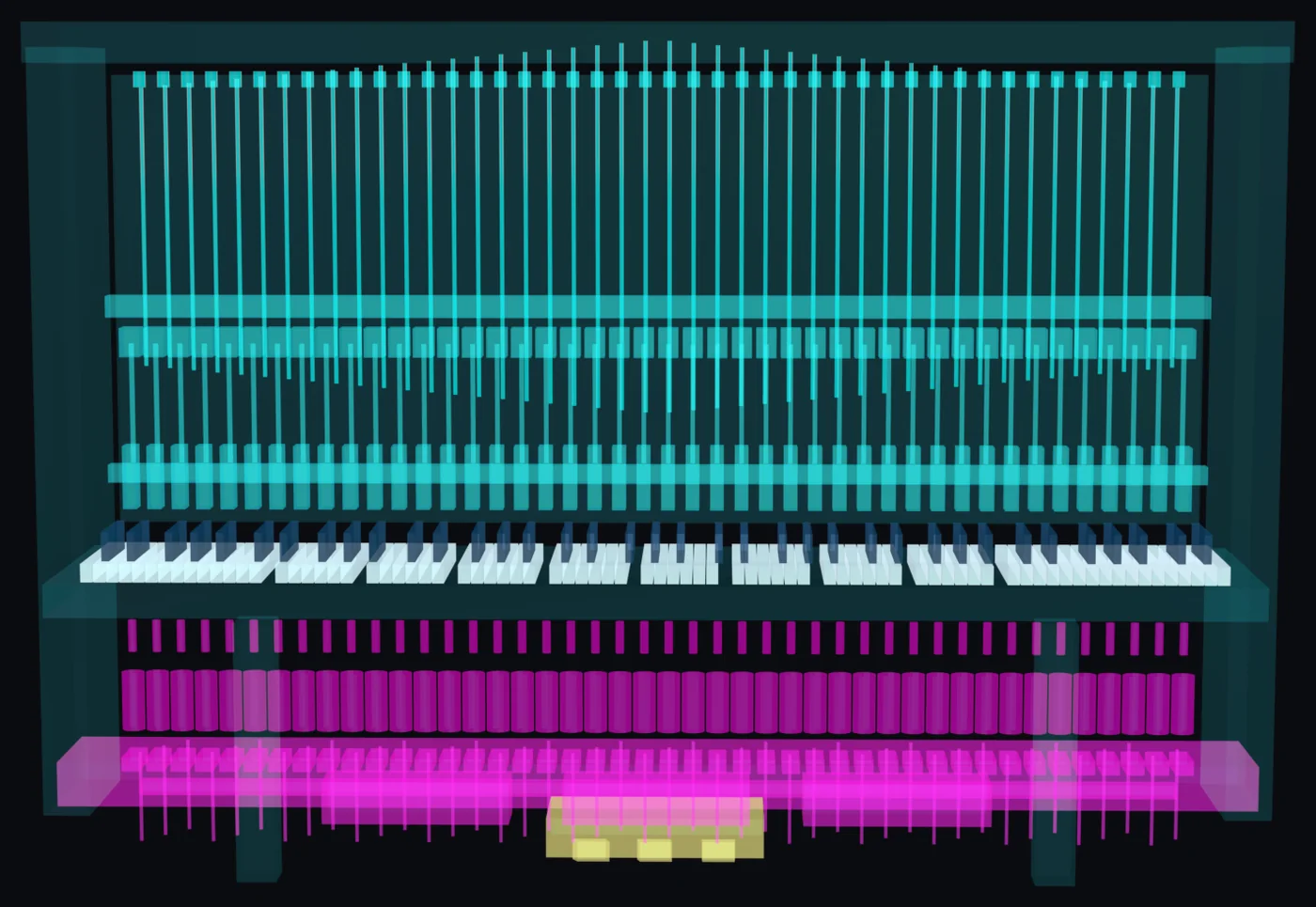
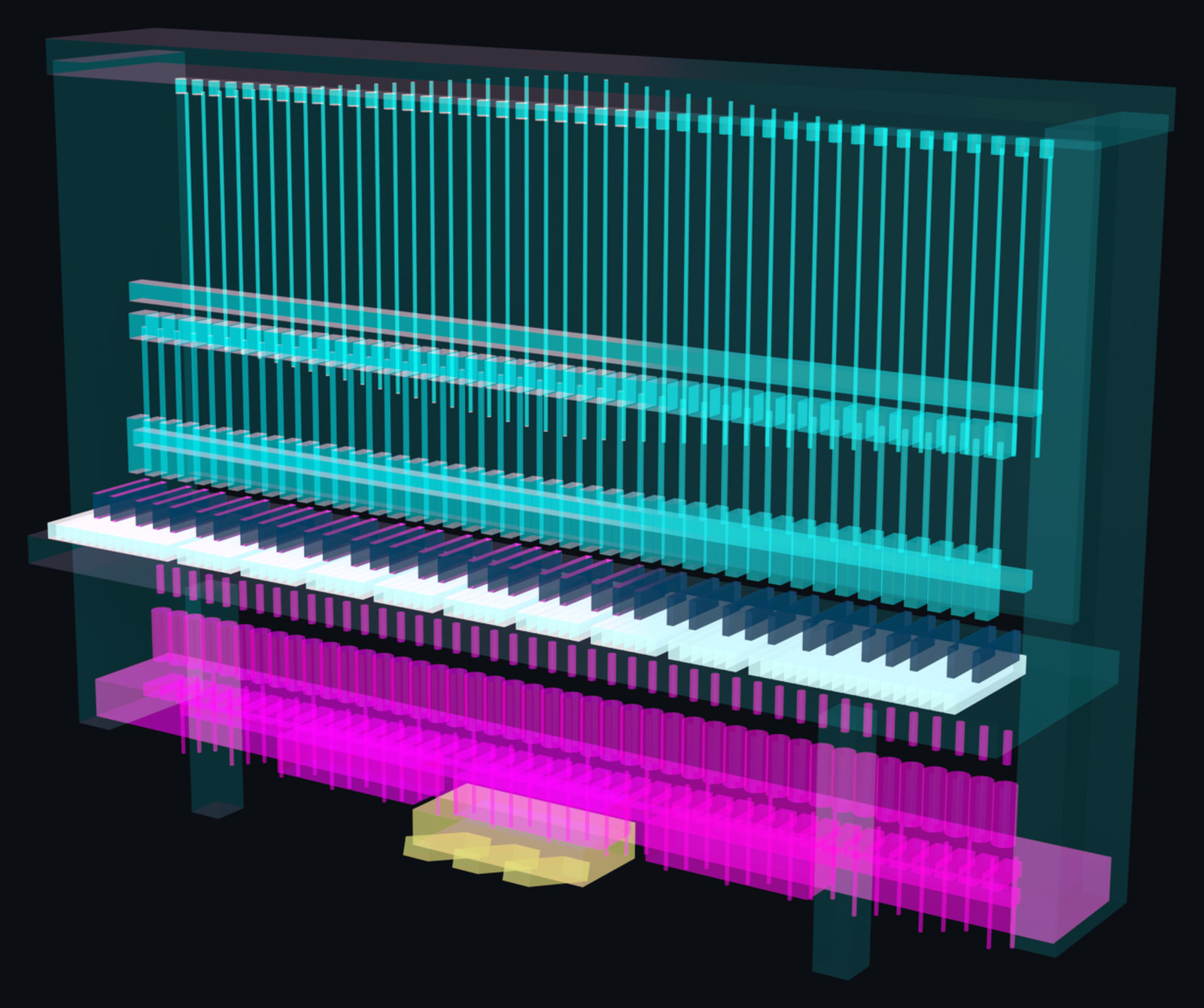
A stranger walks up to an upright piano, says "play something sad in D minor", and the keys move. No screen, no app. Real strings, real hammers, and the only interface is speaking to it.
Ninety-six channels under the keybed — 88 keys, a damper pair, spares. Six driver boards on one bus, one Teensy, a 24 V rail, and a speech pipeline that turns a sentence into a schedule of solenoid pulses.
| Build | Where | Brain | All-in |
|---|---|---|---|
| A — connected | Gallery, venue, home | Raspberry Pi 5, cloud speech | 2166 |
| B — offline | Festival, desert, no signal | Jetson Orin Nano, all local | 2489 |
The actuator half is identical, so building A first and swapping the brain later costs nothing extra and gets sound out six weeks sooner.
- Prices were two years stale. Pi 5 8GB is $175, not the $95 MSRP; the Jetson went $249→$399 in July 2026.
- The piano was not in the BOM. Nor moving it, tuning it twice, the damper actuator, fusing, or an E-stop. About $795 unaccounted.
- Velocity was one line and is really a week. It is a scheduling problem, not a duty cycle — see §09.
- What it got right: the 24 V rail is correctly sized, and one Teensy genuinely beats the two- and three-MCU splits the reference builds use.
The rail as the control surface sees it. Fifty-two white keys, thirty-six black, each depressing and bleeding light when its coil engages, over a strip showing all 88 channels of the bus. Two channels are faulted — ch44 and ch67 — exactly as the reference build reports them.
- Simultaneity, seen. Run CHORD and watch the engaged count. The supply carries 26 at once once fuse and 80% continuous-load derating are applied; MIDI files routinely ask for more, which is why admission control exists in §09.
- Fault legibility. A dead channel has to read as dead from across a room, not as a note that happened not to play.
- Sweep timing. 01→88 at 22 ms is the bring-up test in Stage 4. If it looks wrong here it will sound wrong there.
- PURGE. The E-stop path. Everything releases, the bus goes cold, and the interface says so rather than going quiet.
Musical
Interaction
Electrical
Safety — violating these damages hardware
| Board | Qty | Sheet | Parts | Nets | ERC |
|---|---|---|---|---|---|
| 16-channel solenoid driver | 6 | A2 | 91 | 58 | 0 |
| Controller — Teensy, level shift, 5 V | 1 | A4 | 9 | 15 | 0 |
The 339 off-grid endpoints are the ones that mattered: pins that only looked connected, producing a schematic that renders perfectly and a netlist that is wrong.
Every drawing here is a projection of the actual solid — visible edges in flux blue, hidden in steel. Change a constant at the top of hardware/cad/piano_rig.py and all of them follow, along with the STEP files a fabricator would receive.
| Constant | Meaning | mm |
|---|---|---|
| SOL_L × W × H | Open-frame envelope | 32·22·20 |
| STROKE | Plunger travel | 10.0 |
| KEY_L | Piano key, front to tail | 480.0 |
| PIVOT_X | Balance pin from the front | 180.0 |
| PUSH_X | Where the plunger meets the key | 330.0 |
| LOST_M | Gap — the whole of Stage 5 | 0.5 |
| KEY_PITCH | White key spacing | 23.5 |
Pushing up behind the balance pin is identical to pressing down in front of it. That is why the solenoids hide under the keybed, why the piano still plays by hand, and why nothing is visible from the front.
# plunger tip reaches SOL_H + STROKE above the base;
# drop the solenoid so it lands LOST_M below the key
z = -(SOL_H + STROKE) - LOST_M
sol = solenoid().locate(Location((PUSH_X, 0, z)))
~/.claude/skills/render/.venv/bin/python3 hardware/cad/piano_rig.py
A key is not a switch. Pressing it starts a chain of seven linked parts that ends with a felt hammer thrown at a string and a damper lifted off it — and the retrofit has to drive that chain without altering any of it. Every figure below names the parts a technician names, and every regulation figure is the published vertical-action spec, not an estimate.
Modelled as solids and projected, so the linkage positions are geometry rather than illustration. Watch the hammer: it is thrown, not pushed — the jack escapes 2 mm before the string and the hammer completes the last of its travel on momentum alone.
| Part | What it does to you |
|---|---|
| Capstan | This is where lost motion is normally taken up. Your rod adds a second lost-motion adjustment below the key — set the capstan first, then the rod. |
| Jack / let-off | The hammer is free for the last 2 mm. Pulse energy past let-off does nothing except heat the coil. |
| Backcheck | Catches the hammer 15 mm from the string. If the key is held down by a coil, the hammer stays checked and cannot repeat — this is why R15's auto-off matters musically, not just thermally. |
| Damper spoon | Lifts at about half key travel, so a half-pressed key sustains without sounding. A weak pulse can lift the damper and never strike. |
| Bridle strap | Returns the hammer. It is also the first thing to perish on an old upright — check all 88 before you blame your firmware. |
One octave at true widths — seven naturals at 22.4 mm and five sharps at 11 mm, the sharps starting 95 mm behind the key fronts. This is the pitch the rail has to fit under, and it is why the solenoids sit in two staggered rows.
| Part | Number | Spec | Qty | Ext $ | Basis |
|---|---|---|---|---|---|
| Core actuator rail — both builds | |||||
| Key solenoid | JF-1039B | 24 V, 25 N, 10 mm. Rated 400 mA, measures ~750 mA | 96 | 288 | ALLOW |
| Damper solenoid | JF-1050B | Two in series — one lacks the travel | 2 | 18 | ALLOW |
| Power MOSFET | IRLZ44NPBF | Infineon logic-level, 55 V 47 A, TO-220AB · $0.7642 @100, 26,228 in stock | 100 | 76 | QUOTED |
| Shift register | SN74HC595N | TI 16-PDIP · signal only · $1.37 @10 | 20 | 27 | QUOTED |
| Level shifter | SN74HCT125N | TI · HCT not HC · $0.92 | 5 | 5 | QUOTED |
| Flyback diode | 1N5408 | 3 A 1000 V, one per coil · $0.1331 @100 | 100 | 13 | QUOTED |
| Gate passives | — | 100 R series + 100 k pulldown per channel | 200 | 10 | ALLOW |
| Driver PCB | — | 6 × 16-channel 2-layer, includes one respin | 1 | 85 | ALLOW |
| Connectors | — | 5.08 mm terminals, IDC headers | 1 | 35 | ALLOW |
| Microcontroller | Teensy 4.1 | 600 MHz M7, native USB MIDI · $31.50 in stock · one spare | 2 | 63 | QUOTED |
| Power supply | SE-600-24 | Mean Well 24 V 25 A 600 W · $89.95, 86 in stock | 1 | 90 | QUOTED |
| Bulk capacitance | — | 4700 µF 50 V at each board | 4 | 22 | ALLOW |
| Protection | — | 30 A ANL fuse, mushroom E-stop, DC distribution | 1 | 45 | ALLOW |
| Harness + bus | — | 20 AWG ×500 ft, 8 AWG ×25 ft, ferrules | 1 | 132 | ALLOW |
| Mounting + felt | — | Under-keybed board, rod extensions, damper felt | 1 | 135 | ALLOW |
| CORE RAIL | 1045 | ||||
| Build A — cloud connected | |||||
| Compute | Raspberry Pi 5 8GB | $175 in stock — proposal carried the $95 MSRP | 1 | 175 | QUOTED |
| Pi accessories | — | Cooler, 64 GB A2 card, 27 W supply | 1 | 35 | ALLOW |
| Mic array | reSpeaker XVF3800 | 4-mic, AEC + beamforming, 5 m · $60.99 | 1 | 61 | QUOTED |
| Network | — | Wi-Fi 6 router + LTE fallback | 1 | 55 | ALLOW |
| BUILD A ADD-ON | 326 | ||||
| Build B — fully offline | |||||
| Edge compute | Jetson Orin Nano Super | $399 · DC-native, so no inverter off-grid | 1 | 399 | LISTED |
| Directional mic | — | Shotgun or boundary — crowd noise defeats a 360° array | 1 | 75 | ALLOW |
| Local corpus | — | 1 TB NVMe: MIDI library, Whisper, Ollama weights | 1 | 85 | ALLOW |
| Sealed enclosure | — | NEMA box, MERV-13, positive pressure | 1 | 90 | ALLOW |
| BUILD B ADD-ON | 649 | ||||
| The instrument — absent from the original BOM entirely | |||||
| Used upright piano | — | Free to $400. Play it before you accept it | 1 | 200 | ALLOW |
| Piano moving | — | Local professional, +$40–100 per stair flight | 1 | 275 | MARKET |
| Tuning ×2 | — | Before install and after — the move alone detunes it | 2 | 200 | ALLOW |
| Shop tools | — | Crimper, DMM, current-limiting bench supply | 1 | 120 | ALLOW |
| INSTRUMENT & LOGISTICS | 795 | ||||
| Configuration | Cost | +15% | Proposal |
|---|---|---|---|
| Build A — connected | 2166 | 2491 | 840 |
| Build B — offline | 2489 | 2862 | 1260 |
| Build B + off-grid power | 3339 | 3839 | — |
The 15% contingency is for a first build: one PCB respin, a bag of counterfeit MOSFETs, a solenoid batch that measures differently than the sample. The proposal was not padded — it was scoped to electronics only. About half the gap is the instrument and its logistics; most of the rest is 2026 silicon pricing.
| When | What | $ | Gate |
|---|---|---|---|
| Wk 1 | 5 solenoids, 2 damper units | 80 | none — this is the gate |
| Wk 1–2 | One channel of parts | 40 | S1 passed |
| Wk 3 | PCB + one board's parts | 120 | S2 passed |
| Wk 5 | The big order | 455 | S3 passed |
| Wk 6 | Piano + move | 475 | — |
| Wk 8 | Compute, mic, network | 326 | — |
| Wk 12 | Build B only | 649 | if going offline |
Each stage ends in a test you can pass or fail. Nothing advances on a stage that has not passed — least of all Stage 1, which exists to stop you buying ninety-six of the wrong part.
Qualify the solenoid
You needBench supply with current limit · DMM · kitchen scale · stopwatch
- Order five JF-1039B and two JF-1050B. Nothing else. Three to six weeks if they ship from China — order the day you decide to build.
- 24.0 V, limit 1.5 A. Energise one second and read the current. Expect ~750 mA; the datasheet says 400 and is wrong. Every power calculation downstream uses your number.
- Force: plunger on a kitchen scale, energise, read the peak. Expect ~2.5 kg.
- Thermal: energise continuously and time until too hot to hold. Expect ~40 s. This sets the firmware auto-off. Use a quarter of it.
- On the piano, clamp one under a key tail behind the balance rail with ~0.5 mm gap and pulse it by hand.
- Find the shortest pulse that sounds the note at all — the pianissimo floor.
- Find the pulse that plays it fortissimo. Longer only makes heat. Those two bracket the whole velocity range.
One key plays soft and loud on demand, with four numbers written down. If force is under ~15 N or thermal under 20 s, change the part now — before $288 of solenoids arrives.
One channel, end to end
You needTeensy · 74HCT125 · 74HC595 · IRLZ44N · 1N5408 · oscilloscope
- Build the chain from §04 exactly.
- Before connecting any coil, power the logic with the Teensy unprogrammed and measure the gate. It must read 0 V. If it floats, the pulldown is wrong and every later stage is unsafe.
- Fit the flyback diode before the coil, not after.
- Scope across drain and source. Fire one pulse. With the diode fitted the drain clamps near 24.7 V; without it you would see hundreds. That is why you do not test without it.
- Ten thousand cycles at 1 Hz. Watch for resets; feel the MOSFET.
Key plays over USB MIDI, flyback visibly clamped, no brownouts, cool MOSFET. R12 and R13 demonstrated.
The driver board
- Lay out from §04, or adapt a published reference layout — that can remove a week and a respin.
- Close the sourcing gap first. The schematic ships with only four of twenty-seven parts carrying MPNs. A fab house will not fill them in and a wrong footprint is a respin.
- Order seven boards, not six. The marginal cost is nearly zero.
- Pass one — signal only. Registers, decoupling, pull-ups, bus connectors. No MOSFETs. Hang LEDs off the sixteen outputs and shift a pattern through.
- Pass two — power. Only once the chain is provably correct, fit MOSFETs, gate networks, diodes, terminals.
- Burn in ten minutes, all sixteen. Measure the rail at the board, not at the supply.
Sixteen channels simultaneous for ten minutes, no thermal event, no rail sag. Budget one respin.
All 96 channels on the bench
- Assemble the remaining five boards.
- Build the harness: 96 pairs, ferruled and labelled at both ends. Nobody has regretted over-labelling a 96-way loom.
- Power path: PSU → 30 A fuse → E-stop → distribution → six boards in 8 AWG. Bond signal to power ground at exactly one point.
- Bulk capacitors at each board, not at the supply — they hold the rail up during the strike, and that only works locally.
a. E-stop pressed. b. Teensy disconnected. c. Energise and confirm every gate reads 0 V. d. Release the E-stop; confirm nothing twitches. e. Connect a Teensy running firmware that does nothing; confirm still nothing. f. Only now load the driver firmware.
If anything moves at c, d or e, stop. That is R17 failing, and it is the failure that burns coils.
- Implement the safety layer from §09.
- Then try to break each rule deliberately: forty simultaneous notes, a note-on with no note-off, USB yanked mid-chord. Each must fail safe.
Every channel addressable, and R15–R17 each demonstrated by actively trying to violate them.
Mechanical integration
This is the stage that decides whether the project finishes. Ninety-six individual adjustments. It cannot be rushed, delegated or parallelised — give it three weeks of calendar and schedule nothing against it.
- Photograph everything before you touch it.
- Remove the action, labelling as you go. It only goes back one way.
- Measure on the instrument: front to balance pin, pin to push point, key tail travel. The lever ratio tells you how much stroke you actually need.
- Build the mounting board. Two staggered rows — §05 shows why one will not fit.
- Mark drill positions from the keys themselves, not from a drawing. Key spacing on a real piano is not uniform and a drawing is wrong by the third octave.
- Drill. This is the irreversible step.
- Fit rod extensions and set each tip 0.5 mm below its key at rest.
- Set lost motion on all eighty-eight. Too much and the note is late and weak; too little and the key never returns and will not repeat. This is the twenty hours.
- Felt every contact. Silicone-grease the action pins. The click is the difference between an instrument and a machine.
- Reinstall and play it by hand. If the touch feels different, you are not finished.
All 88 play from the rail, the piano still plays normally under your fingers (R6), no audible clack.
Damper pedal
- Wire the two JF-1050B in series. One alone lacks the travel — a known trap that costs an evening.
- Mount near the pedal lever fulcrum, pushing down on the bottom board.
- Drive from channel 89, triggered by CC 64.
- Confirm the pedal still works under a foot.
Sustain audibly changes the decay. Cheapest musical improvement in the build.
Voice pipeline · parallel from week 2
This is why the schedule is thirteen weeks and not nineteen. The stack targets a virtual MIDI port, so it is built and tested from week two while the hardware is still parts in boxes.
- Assemble and index the MIDI corpus — title, composer, key, tempo, mood.
- Speech to text; confirm it transcribes at three metres with music playing.
- Intent parsing: "something sad in D minor" → structured query.
- Fuzzy search over the corpus, plus a generative fallback.
- Dispatcher streaming MIDI to the controller, pointed at the virtual port.
Spoken request → correct MIDI in under three seconds, and an unrecognised request produces a spoken reply rather than silence (R10).
Velocity calibration
- Sweep the velocity-phase duration for one note across the Stage 1 range, firing each step with a gap.
- Record peak level for every step; fit a curve mapping MIDI 1–127 to pulse duration.
- Repeat for all 88. Automate it — 88 × 8 points by hand is a weekend.
- Tune activation duration per note. Bass hammers are heavier and need longer to move.
- Settle hold duty by ear: full duty is quieter mechanically but hotter; reduced duty at high PWM is cooler but can sing.
A chromatic scale at one MIDI velocity sounds even across all 88. Audible, not measurable on paper.
Integration and soak
- Point the dispatcher at the real controller.
- Play something dense and pedal-heavy. Watch the rail; listen for late notes.
- Two hours continuous unattended, then walk away.
- Return and check: stuck notes, dropped notes, warm boards, brownouts in the log.
Two hours, no thermal event, nothing stuck or dropped. If it survives this it will survive an audience.
Hardening and deployment
- Seal compute and drivers in a NEMA enclosure at positive pressure behind filtered fans. Air enters only through a filter.
- MERV-13 media, treated as a consumable. Carry spares.
- Optically isolate driver ground from the host so switching transients cannot reset the compute box.
- Move the stack fully local and test with the network physically unplugged (R9). Not airplane mode — unplugged.
- Size the power: a 2–2.4 kW inverter generator, or LiFePO₄ with solar. The Jetson's DC input removes the inverter from the compute half.
- Tune the piano after transport, then write the runbook.
A full day in dust, no filtered-air loss, no host resets, and a stranger able to walk up, speak, and hear it play.
Five stages between a sentence and a note, and a hard boundary in the middle. Everything left of the MIDI line is Python on the host and may be slow; everything right of it is C++ on the Teensy and may not.
"Play something sad" only works if the corpus is tagged, and raw MIDI files are not. Budget time for indexing: title, composer, key, tempo, mood. Key and tempo come out of the files; mood does not, and is worth a one-off pass with a language model over titles and metadata before deployment rather than at request time.
Ninety-six channels of independent PWM is more than any microcontroller has in hardware. The answer is to hold a 96-bit shadow register, recompute it at the PWM tick, and clock the whole frame out to the chained 74HC595s. A Teensy 4.1 at 600 MHz does this with room to spare — an RP2040 at 133 MHz manages 256-level PWM on the same topology using DMA, so headroom is not the constraint.
verify/ finding F2: the 560 R gate resistor that keeps the 74HC595 inside its package rating slows the edge to 4.13 µs, so at 20 kHz crossover loss is 1.49 W per channel — a 92 °C junction rise. Velocity comes from pulse duration, so PWM is only needed for the hold phase, where 1 kHz costs 0.074 W. Coil singing at that rate is a real risk and is on the M5 list.A solenoid moving a key is not on or off. OFF → ACTIVATION → VELOCITY → ON → DEACTIVATION. Activation runs at full duty to overcome inertia, fixed and calibrated per note. Only the velocity phase carries loudness. Feeding MIDI velocity straight to a duty cycle skips the momentum phase, so quiet notes fail to speak and loud ones arrive late.
Because every note takes a different time to reach the key, scheduling works backwards from a universal key delay — schedule the final state first, then place activation and velocity behind it. Chords land together instead of arpeggiating themselves (R5), at the cost of a fixed latency nobody can hear.
// none of these are configurable at runtime
constexpr uint32_t MAX_ON_MS      = 10000;  // R15: coil cooks at ~40 s
constexpr uint8_t  MAX_SIMULTANEOUS = 30;     // R16: supply, not musicality
constexpr uint32_t HOST_TIMEOUT_MS = 500;    // R17: silence means stop

void serviceSafety(uint32_t now) {
  // R15 — force-release anything held too long, whatever MIDI says
  for (uint8_t ch = 0; ch < N_CHANNELS; ++ch)
    if (state[ch] == ON && now - onSince[ch] > MAX_ON_MS)
      forceRelease(ch, "held past thermal limit");

  // R17 — a quiet host is a dead host
  if (now - lastHostMsg > HOST_TIMEOUT_MS) allChannelsOff();

  // R14 — the E-stop cut the rail; stop pretending we are playing
  if (analogRead(PIN_RAIL_SENSE) < RAIL_LIVE) {
    allChannelsOff();
    reportToHost("24V rail down — E-stop or fuse");
  }
}
- E-stop pressed. Power the compute box first and let it boot fully.
- Confirm the controller enumerates and reports the rail as down.
- Release the E-stop. Confirm no key moves.
- One test note, then a test chord.
- To stop: halt playback, press the E-stop, then power down the compute box.
- Every event: confirm the E-stop actually cuts the rail. Ten seconds, and it is the one control that matters.
- Monthly / after any move: tune, and spot-check regulation on a dozen keys across the range.
- Outdoors: change enclosure filters on schedule. Positive pressure only works while air can get in.
- Annually: re-run the full velocity calibration. Felt compresses; lost motion drifts.
| Symptom | Most likely cause |
|---|---|
| One note never sounds | Lost motion too large on that key, or a dead channel. Fire it and listen for the plunger. |
| One note always quiet | Stale calibration — re-sweep that note only |
| A note sticks on | Shorted MOSFET or a floating register. E-stop immediately — firmware gives you ten seconds, then it is on you |
| Notes drop in dense passages | Admission control working as designed. Check the rail is not sagging first. |
| Chords arpeggiate | Universal key delay too short. Raise it. |
| Buzzing while held | Hold PWM in the audible band — raise toward 12–20 kHz |
| Host resets mid-chord | Check every flyback diode, then that grounds bond at exactly one point |
| Whole rail dead | Fuse or E-stop. The controller should already be telling you which. |
| Piano feels wrong to play | Violates R6. Find it before playing the instrument again. |